


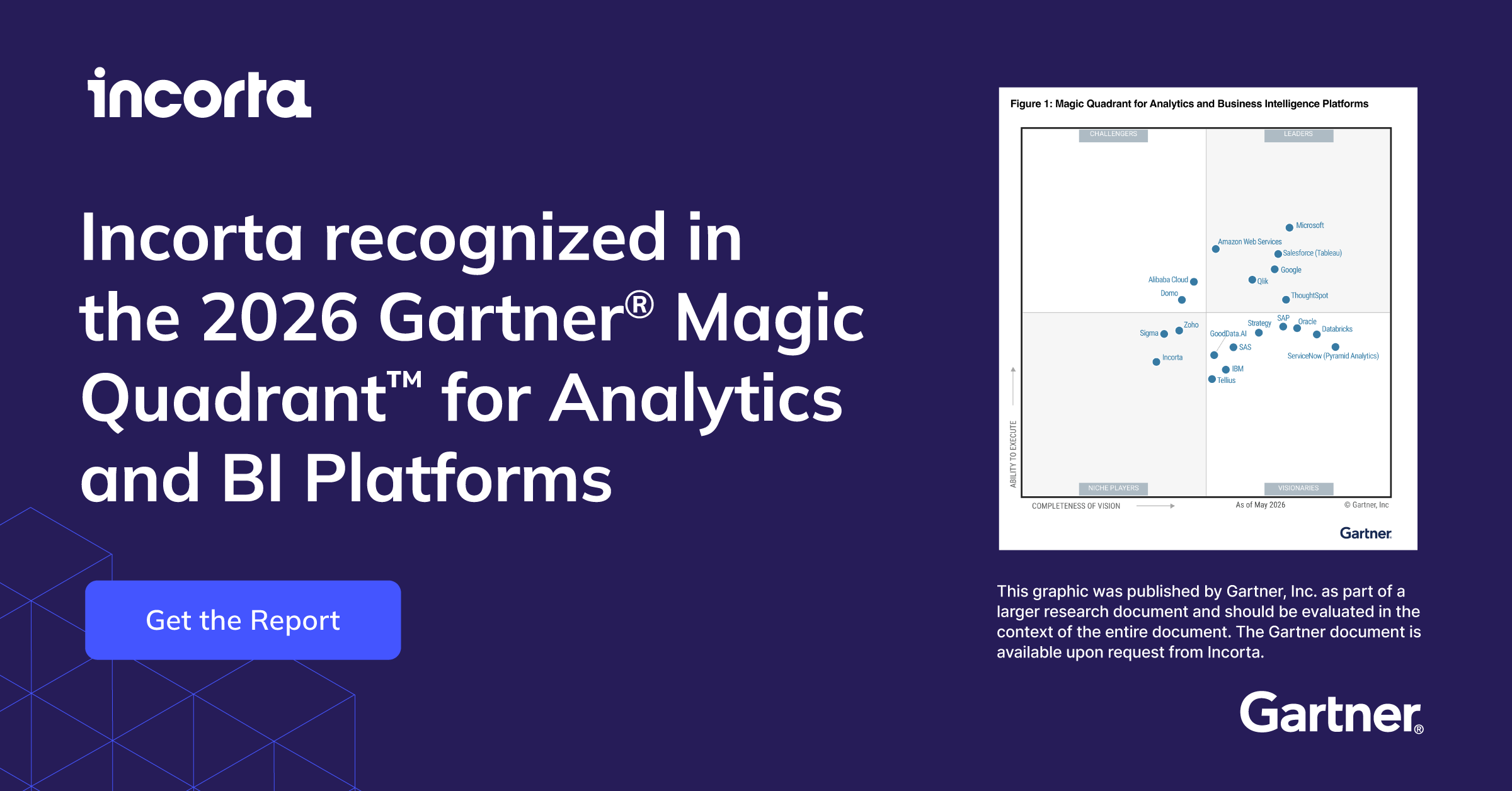

Incorta has been recognized for the fifth consecutive year in the 2026 Gartner® Magic Quadrant™ for Analytics and Business Intelligence Platforms. Among the results we are most proud of this year, Incorta ranked among the 6 highest scoring vendors for Governance Use Case in the 2026 Gartner Critical Capabilities report - across all 20 vendors evaluated.
To us, that score reflects something we have long believed: governance is no longer a compliance checkbox. For enterprises running complex operational data, it is the foundation that determines whether analytics actually gets used - and trusted - in production.
The Governance gap no one talks about
Enterprise analytics projects fail more often than the industry likes to admit. Not because the technology doesn't work, or because the dashboards aren't well designed. They fail because the data underneath can’t be trusted.
A finance leader who has been burned by a report that contradicts the one their colleague pulled an hour earlier will stop using the tool. A supply chain team that cannot trace where a KPI came from will build its own spreadsheet instead. An IT organization that cannot prove audit-ready lineage from source to dashboard will block the rollout entirely.
Enterprise environments running on Oracle or SAP run into this all the time - the data is complex and vast, user expectations are demanding, and the cost of a wrong number is significant.
Governance prevents this - so why do most enterprises still treat it as an afterthought?
What Governance actually means in enterprise analytics
Governance in enterprise analytics is less of a feature, more of an architectural commitment. When your data comes from Oracle or SAP, the security models, the business definitions, and the data lineage all need to be inherited from the source - not reconstructed on top of it. That is what Incorta was built to deliver.
We feel this year's recognition highlights the depth of that commitment across four capabilities that together define what governed analytics looks like in practice:
4-Layer Security: Row-level, column-level, object-level, and data classification security -with permissions inherited directly from Oracle and SAP rather than manually mapped in the analytics layer. When a user's access changes in the source system, it is reflected immediately in Incorta. There is no secondary security model to maintain and no risk of the two falling out of sync.
Certified Business Views: A single trusted definition for every metric across the organization. Revenue means the same thing to the CFO as it does to the regional sales lead. Inventory turn is calculated consistently whether it appears in a finance dashboard or a supply chain report. Certified business views eliminate the competing definitions that quietly undermine confidence in analytics platforms over time.
End-to-End Data Lineage: Full lineage from source ERP system to dashboard - traceable, auditable, and available out of the box. When a regulator asks where a number came from, or when an analyst needs to understand why a metric changed, the answer is available without a forensic investigation. This is not a feature most platforms offer at the depth enterprise compliance teams require.
Crowdsourced Trust Layer: Business users can rate, review, and flag data quality on certified views - giving data teams a continuous feedback loop on what is working and what is not. This shifts data confidence from a centralized IT responsibility to a shared organizational practice, and it surfaces issues before they become decisions.
Why being listed matters to us in context
Gartner evaluates Analytics Governance across all 20 vendors in the report - platforms with significantly larger market share, broader global footprints, and extensive enterprise sales organizations. Incorta ranked among the 6 highest scoring vendors for Governance Use Case. .
To us, that reflects a deliberate product philosophy. Incorta was not built as a general-purpose BI tool that added governance capabilities over time. It was built for complex enterprise ERP data from the ground up -which means governance is not a layer on top of the platform. It is the platform.
For enterprises in finance, healthcare, and manufacturing - where compliance is non-negotiable and data errors have real consequences -that distinction matters more than quadrant position.
Governance as a competitive moat
The analytics market is moving fast. AI capabilities are being added to every platform, natural language querying is becoming table stakes, and vendor positioning is shifting quickly - as this year's Magic Quadrant illustrates, with AWS entering the Leaders quadrant, Databricks making its first appearance, and several established vendors declining on Ability to Execute.
In an environment where features converge rapidly, governance is the capability that is hardest to replicate. It requires architectural decisions made early, deep integration with source systems, and a sustained commitment to the trust layer that makes analytics usable at scale. Platforms that prioritize speed to market over structural integrity will struggle to close that gap retroactively.
For the enterprises evaluating analytics platforms in 2026, the question is not only which vendor has the most capabilities - it is which vendor's platform will still be trusted by business users a year after go-live.
That is the competitive moat governance builds - and it’s why we believe this score is the most meaningful result in this year's evaluation.
Get your own copy of the 2026 Gartner® Critical Capabilities [here]
Gartner and Magic Quadrant are trademarks of Gartner, Inc. and/or its affiliates.
Gartner does not endorse any company, vendor, product or service depicted in its publications, and does not advise technology users to select only those vendors with the highest ratings or other designation. Gartner publications consist of the opinions of Gartner’s business and technology insights organization and should not be construed as statements of fact. Gartner disclaims all warranties, expressed or implied, with respect to this publication, including any warranties of merchantability or fitness for a particular purpose.
Gartner, Magic Quadrant for Analytics and Business Intelligence Platforms, Anirudh Ganeshan, Christopher Long, Edgar Macari, 29 June 2026.
Gartner, Critical Capabilities for Analytics & Business Intelligence Platforms, Edgar Macari, Christopher Long, Anirudh Ganeshan, 15 July 2026.