


.png)

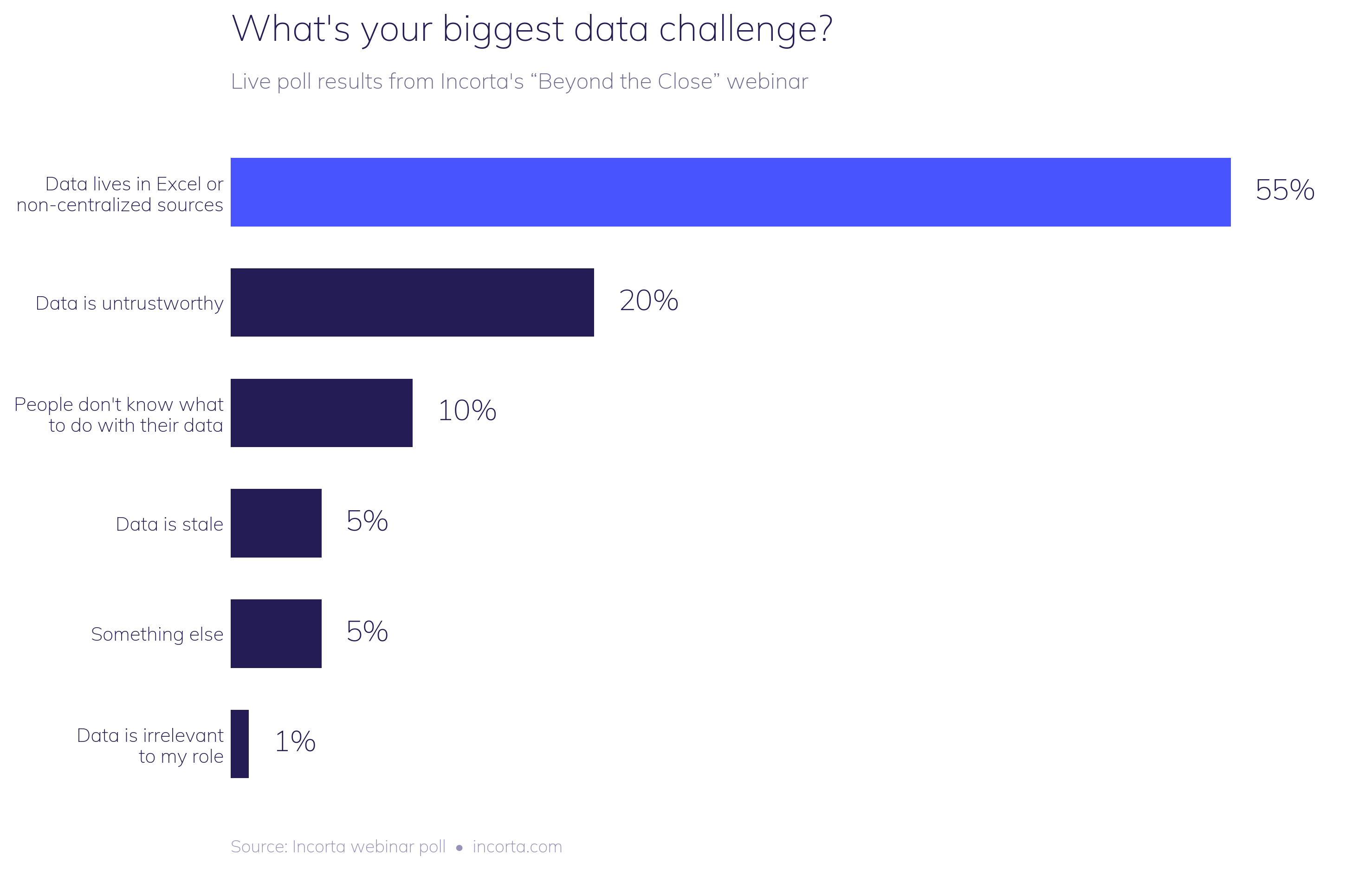
At Incorta's "Beyond the Close" webinar, 20% of attendees pointed to untrustworthy data as their biggest challenge, right behind the 55% stuck in Excel. Twenty percent might sound manageable next to a majority-vote problem. It isn't. It means a meaningful share of finance leaders are making decisions on numbers they don't fully believe, and saying so out loud in a room full of peers.
Mike Nader, Field CTO at Incorta, put the underlying issue plainly during the session: finance and accounting teams have to be able to communicate in a common way, and that starts with agreeing on what a number actually means. Without shared rules and shared context, two people can look at the same figure and mean two different things by it.
Trust breaks down before AI ever enters the room
Data doesn't become untrustworthy on its own. It happens gradually, through a specific set of failures that show up in almost every finance function at some point.
Systems get connected by hand instead of through a governed pipeline, so every export is a fresh opportunity for something to drop or duplicate. Business rules live in someone's head, or in a spreadsheet formula nobody's touched in two years, instead of in a place the whole team can see and reference. There's no lineage, so when a number looks off, nobody can quickly trace it back to the transaction that produced it. And definitions drift. One team's "active customer" is another team's "customer with an order in the last 12 months," and nobody notices until the two reports don't match.
Any one of these is manageable. Stacked together, they're exactly why a fifth of a finance audience will say out loud that they don't trust their own numbers.
AI will expose a broken data foundation, not repair one.
Cloudera's 2026 Data Readiness Index surveyed 1,270 IT leaders and found that while 85% believe they have a clear data strategy, only 18% consider their data fully governed. Informatica's CDO Insights 2026 study of 600 global data leaders found that 76% say their organization's AI governance can't keep pace with how employees are actually using AI day to day. And Grant Thornton's 2026 AI Impact Survey found that 78% of business executives lack confidence they could pass an independent AI governance audit within 90 days.
The same governance gap showing up in finance teams' Excel workflows is showing up across every function racing to adopt AI, and finance has more exposure than most, because nearly every decision in a company eventually shows up as a financial outcome.
Point an AI model at ungoverned, disconnected data and it won't hesitate the way a skeptical analyst would. It'll answer confidently, using whatever pattern it finds, whether or not that pattern reflects what's actually happening in the business. The output looks polished. The trust problem is just harder to see until something goes wrong.
What trustworthy data actually requires
Fixing this isn't about finding a smarter model. It's about giving finance a data foundation that's governed at the source, not cleaned up after the fact.
That means data landing exactly as it looks in the system of record, with no undocumented transformation on the way in. It means rules and business logic applied consistently, in a shared semantic layer instead of scattered across individual spreadsheets. It means every number staying traceable, so a finance user can walk from a summary figure back to the line-level transaction that produced it, in a few clicks, without filing a ticket. And it means that same foundation, and the same governance, applying whether a person is asking the question or an AI agent is.
That last point matters more every quarter. An agent answering a finance question needs to inherit the same row-level security and the same audit trail a human user would get from a dashboard. Otherwise, adding AI just adds a new, faster way to act on bad data.
Finance teams didn't lose trust in their data because they weren't paying attention. They lost it because the systems underneath weren't built to keep pace with how fast the business changes. Closing that gap takes a foundation that's governed from the moment data lands, not a faster way to query whatever's already there.