


.png)

What's actually slowing finance down
We polled the room on their biggest data headache, and one answer stuck out immediately:
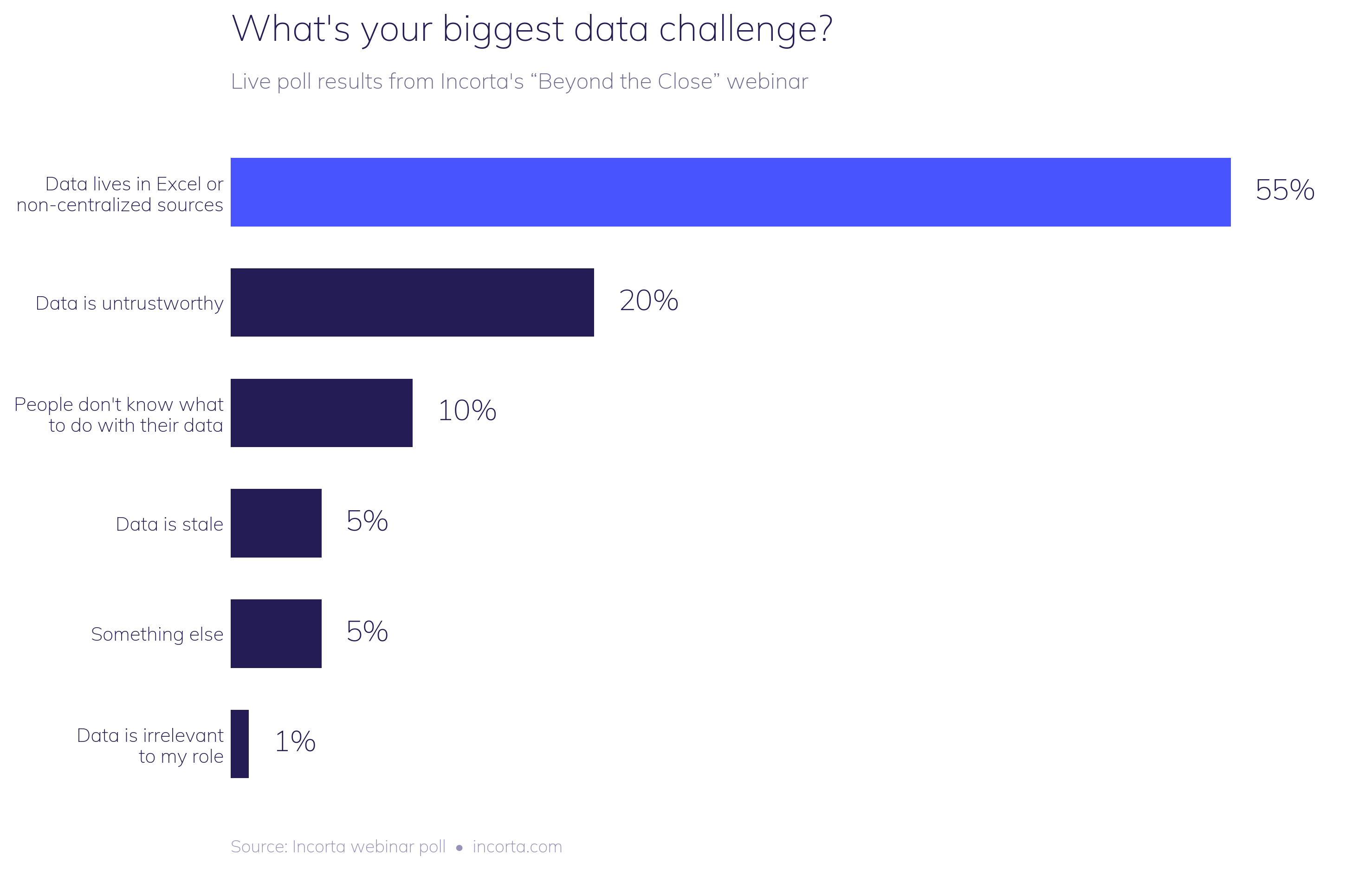
More than half the room is still fighting Excel for control of their own numbers, and another fifth doesn't trust the data they do have. That's three out of every four attendees stuck at the most basic layer of the problem before they can even get to decision making.
The four pillars of continuous financial signaling
Mike Nader, Field CTO at Incorta, and Ben Pierce, General Manager of Workday Adaptive Planning, walked us through what it actually takes to move finance from reporting the past to guiding what happens next.
1. Connect operational and financial data into a single governed access point. Not just a dashboard, but a place where a finance user can drill from a KPI down to the transaction that explains it.
2. Shift from analytics to decision making. Seeing an alert isn't enough. Teams need to understand why something is happening, model out a few scenarios, and act on it in the same period, not after the fact.
3. Let finance own its data, without losing governance. The goal is fewer tickets to IT for routine questions, not fewer controls. Owning the data and governing it aren't in conflict.
4. Build the foundation AI actually needs. AI doesn't fix broken data - it just makes the cracks more visible, faster. If financial context isn't connected to the rest of the business, AI has nothing solid to reason over, and every decision a company makes eventually shows up as a financial outcome anyway.
The demo: walking a number all the way back to its source
Mike's demo centered on Adaptive Decision Intelligence, now part of Adaptive Pro licensing. He asked it a series of increasingly specific questions about a top customer: purchase history, growth forecast, channel rankings. Then he asked one it couldn't yet answer: whether the customer's open orders, fulfillment rates, and cancellations pointed to a forecasting risk.
That's where he pivoted to the Adaptive Data Foundation, powered by Incorta, and showed how the underlying data gets there in the first place. It's pulled directly from source systems like SAP or Oracle, mirrored without transformation, then enriched with business rules that stay fully traceable. Every formula, every derived field, every source system it came from is logged in the data catalog and can be walked back on demand.
Ben, watching it live, compared it to solving a problem he's seen at nearly every planning customer: building a real semantic layer instead of forcing users to understand joins and pull raw tables out of a system like Oracle EBS by hand.
From the Q&A
A few questions from the audience got at what teams actually want to know before adopting this.
Is this the same as the Adaptive Planning interface? No. Incorta and Workday have partnered for years, going back to a shared customer that connected the two products independently before the formal partnership existed. Workday now stands behind the Adaptive Data Foundation as part of its embed program, with joint product work on drill-through and security.
How does security work across both systems? Templates mirror Adaptive's security model directly in the data foundation. If a user can't see certain revenue lines in Adaptive, they won't see them in the transaction-level data either.
Does data need to be cleaned before it connects to Incorta? No. Mike was emphatic that data should land exactly as it looks in the source system, with enrichment and rules applied afterward, not during ingestion. That preserves lineage instead of hiding it.
How do you keep an AI agent from acting on a number that's technically correct but contextually wrong? Mike's answer came down to scope: define the job the agent is doing, then define exactly which actions are legitimate for it to take, whether that's answering a question or actually modifying a plan. Everything stays inside the same governance model as the rest of the platform.