


.png)

The number that wasn't surprising
During our latest webinar with Workday Adaptive Planning, we asked the audience a simple question: what data challenge is causing you the biggest headache right now? Fifty-five percent said the same thing. Their data lives in Excel or some other non-centralized source.
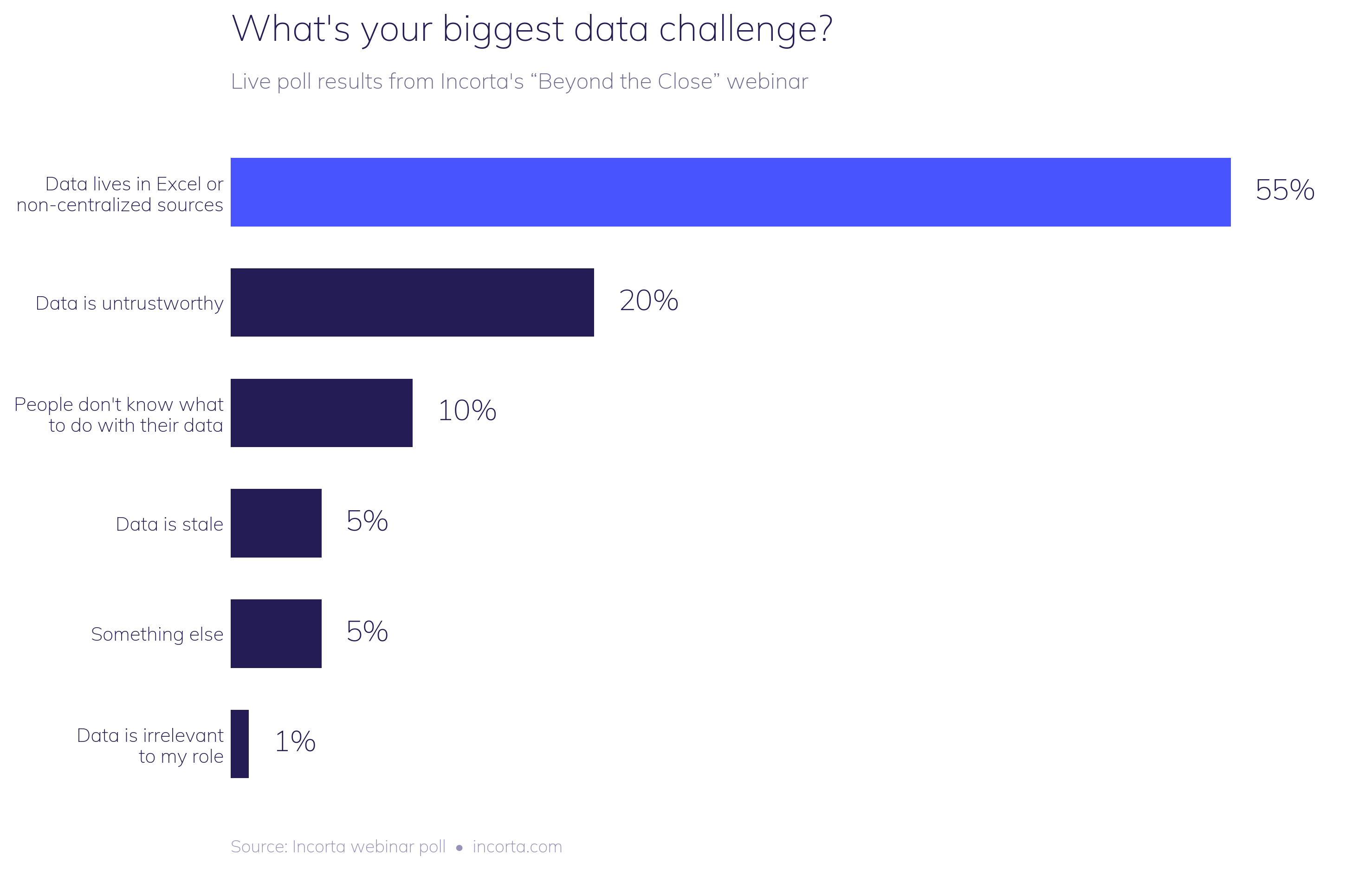
Nobody on the call was shocked. Ben Pierce, General Manager of Workday Adaptive Planning, walked through the pattern right after the results came in: a finance team needs a view their BI tool doesn't have, so they pull data out of the ERP, drop it into a spreadsheet, and spend the next several hours building VLOOKUPs and pivot tables just to get back to a starting point. Most of the effort goes into wrangling the data instead of actually analyzing it.
Why it hasn't gone away
Analysts have been predicting Excel's decline for years. Gartner has forecast that by 2026, more than 70% of finance organizations will have moved off spreadsheets as their primary planning tool. But the Association for Finance Professionals' 2025 FP&A Benchmarking Survey tells a different story: 96% of finance practitioners still use spreadsheets weekly for planning, and 93% use them weekly for reporting, even at companies that already run a dedicated EPM platform.
Read those two data points side by side and the gap is hard to miss: trhe prediction and the reality aren't close.
And we get it! Excel is fast, familiar, and flexible in ways purpose-built systems often aren't. Nearly every finance professional already knows how to use it, so there's no training curve and no waiting on IT. When a forecast needs updating before a Monday meeting, Excel is usually the quickest way to get there.
The problem shows up later, once that spreadsheet becomes the system of record for a decision instead of a scratchpad for one.
What it's actually costing
A few things happen once Excel becomes the default workflow instead of a backup option.
Time disappears into data prep instead of analysis. The AFP numbers above aren't describing a minority workaround. They're describing how most finance teams spend most of their week, and it's rarely on the parts of the job that actually move the business forward.
Trust erodes. UK research from Sixthfin, covered by The Fintech Times, found that 67% of firms still run their financial close in Excel, and roughly a third of finance leaders admit they don't fully trust the reliability of their own close figures. When a number can't be traced back to its source with confidence, every conversation built on that number starts from a weaker position.
Errors compound quietly. Spreadsheets have no native audit trail. There's no built-in way to see who changed a formula, when, or why. A single broken link or copy-paste error can sit undetected for a full reporting cycle, and by the time it surfaces, it's already shaped a decision.
The close gets harder every month, not easier. Every one of those workarounds gets rebuilt from scratch next period. Nothing compounds in the team's favor. The same manual work just repeats.
The fix isn't telling finance to give up Excel
Every attempt to force finance teams off spreadsheets by fiat runs into the same wall: Excel solves a real problem, and ripping it away without solving that problem first just pushes the workaround somewhere else.
The actual fix is giving finance direct, governed access to live operational data, so the spreadsheet stops being the only place that data can be shaped and explored. During the Incorta Builder launch webinar, this showed up directly in the forecast and planning app demo: users got an editable, grid-based planning interface that felt like Excel to work in, drag, fill, adjust assumptions, but every number underneath it was live, governed, and tied back to its source. Saving a plan wrote directly to the underlying database instead of creating another disconnected file that only one person understands.
That's the shift: not eliminating the spreadsheet experience finance teams are comfortable with, but connecting it to a foundation where the data is trustworthy, current, and traceable by default.
The real opportunity is closing the gap between the flexibility finance teams need and the governance the business actually requires, so teams stop rebuilding the same workaround every month and start working from data they can trust the first time.