


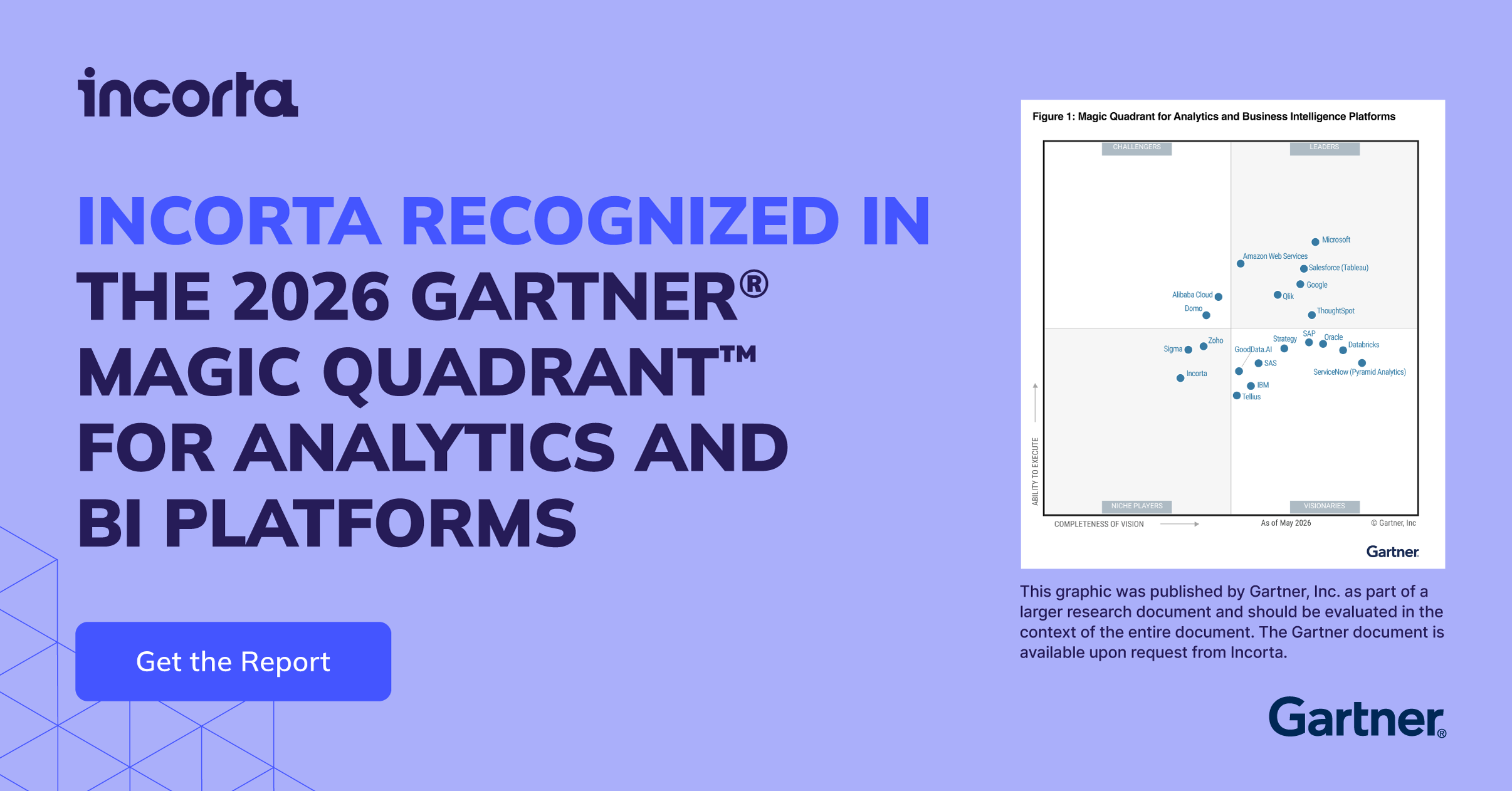

Incorta has been recognized as a Niche Player for the fifth consecutive year in the 2026 Gartner® Magic Quadrant™ for Analytics and Business Intelligence Platforms. We think this recognition reflects our continued commitment to our platform's evolution to meet the demands of the next generation of enterprise data.
Each time, the Gartner Magic Quadrant offers more than a vendor evaluation according to us. To us, the capabilities Gartner chooses to evaluate are one of the clearest signals in the industry of where enterprise analytics is actually heading.
Their addition is not a coincidence in our opinion. It reflects that AI has moved from a feature to foundational infrastructure - and that enterprise buyers are now actively evaluating platforms on their ability to deliver it at scale.
Redefining What Enterprise Analytics Needs to Do
The addition of AI-native capabilities to the Gartner® evaluation framework confirms, as per us, what we have been building toward. Enterprises don't want AI bolted onto a BI tool. They want it embedded in a platform that already understands their ERP data -the schemas, the security models, the business context. That is exactly where Incorta operates.
We feel this year's recognition highlights not only our execution and vision, but the platform's readiness to deliver on the AI capabilities now being formally evaluated across the industry.
Agentic Insights: From Reactive Reporting to Proactive Intelligence
To us, the addition of Agentic Insights to Gartner evaluation reflects a fundamental shift in what enterprise analytics is expected to do. Agentic analytics moves beyond answering questions to proactively surfacing what matters: identifying anomalies, flagging risks, and triggering actions without waiting for a human prompt.
For enterprises running on Oracle or SAP, this is especially critical. The volume of operational data flowing through ERP systems is too large for any analytics team to monitor manually. Agentic capabilities allow the platform to watch that data continuously - surfacing a supplier performance deviation, a cash flow anomaly, or a production yield drop before it becomes a problem.
This is the shift from analytics as a reporting layer to analytics as an active participant in operational decision-making.
Semantic Modelling: The Foundation AI Requires
Semantic modelling has long been a differentiator for platforms built around ERP data - and the decision by Gartner to formally evaluate it reflects the pressure that AI-powered querying is placing on the entire analytics stack.
As natural language interfaces become standard, the semantic layer becomes the foundation everything else depends on. A model that does not understand what "close cycle time" means in the context of a finance team, or what "on-time delivery" means against a specific SAP schema, will break down the moment it moves from demo to deployment.
Semantic modelling done at the ERP level -with business context, governed definitions, and certified metrics built in - is what separates platforms that work in production from those that work in a proof of concept.
Conversational Analytics: Closing the Distance Between Data and Decision-Makers
Conversational analytics is often the most visible AI capability to end users and the most discussed in vendor marketing. Evaluated seriously, however, it is a test of something more fundamental: whether an analytics platform can extend trusted data access across an entire organization -not just to analysts and data engineers, but to the VP of Supply Chain who needs an answer before a Monday morning standup.
The bottleneck in enterprise analytics has rarely been the data itself. It has been the distance between the people who have questions and the people who know how to query. Conversational analytics, built on a strong semantic and governance foundation, is what closes that gap at scale.
What This Means for Enterprise Buyers in 2026
The platforms that perform well here are built for the way enterprise analytics needs to work: proactive, conversational, semantically aware, and deeply integrated with the operational systems the business runs on.
For teams running on Oracle or SAP, the evaluation criteria matter even more. Complex data structures, non-negotiable governance requirements, and business users who can’t wait on IT for a new report to be built - these are the conditions that separate purpose-built ERP analytics platforms from general-purpose BI tools retrofitted with AI features.
Incorta was built for this environment. We believe being evaluated in all three of these capabilities for the first time in 2026 reflects where the platform has been investing - and where enterprise analytics is heading.
Gartner, Magic Quadrant for Analytics and Business Intelligence Platforms, Anirudh Ganeshan, Christopher Long, Edgar Macari, 29 June 2026.
Gartner and Magic Quadrant are trademarks of Gartner, Inc. and/or its affiliates.
Gartner does not endorse any company, vendor, product or service depicted in its publications, and does not advise technology users to select only those vendors with the highest ratings or other designation. Gartner publications consist of the opinions of Gartner’s business and technology insights organization and should not be construed as statements of fact. Gartner disclaims all warranties, expressed or implied, with respect to this publication, including any warranties of merchantability or fitness for a particular purpose.